
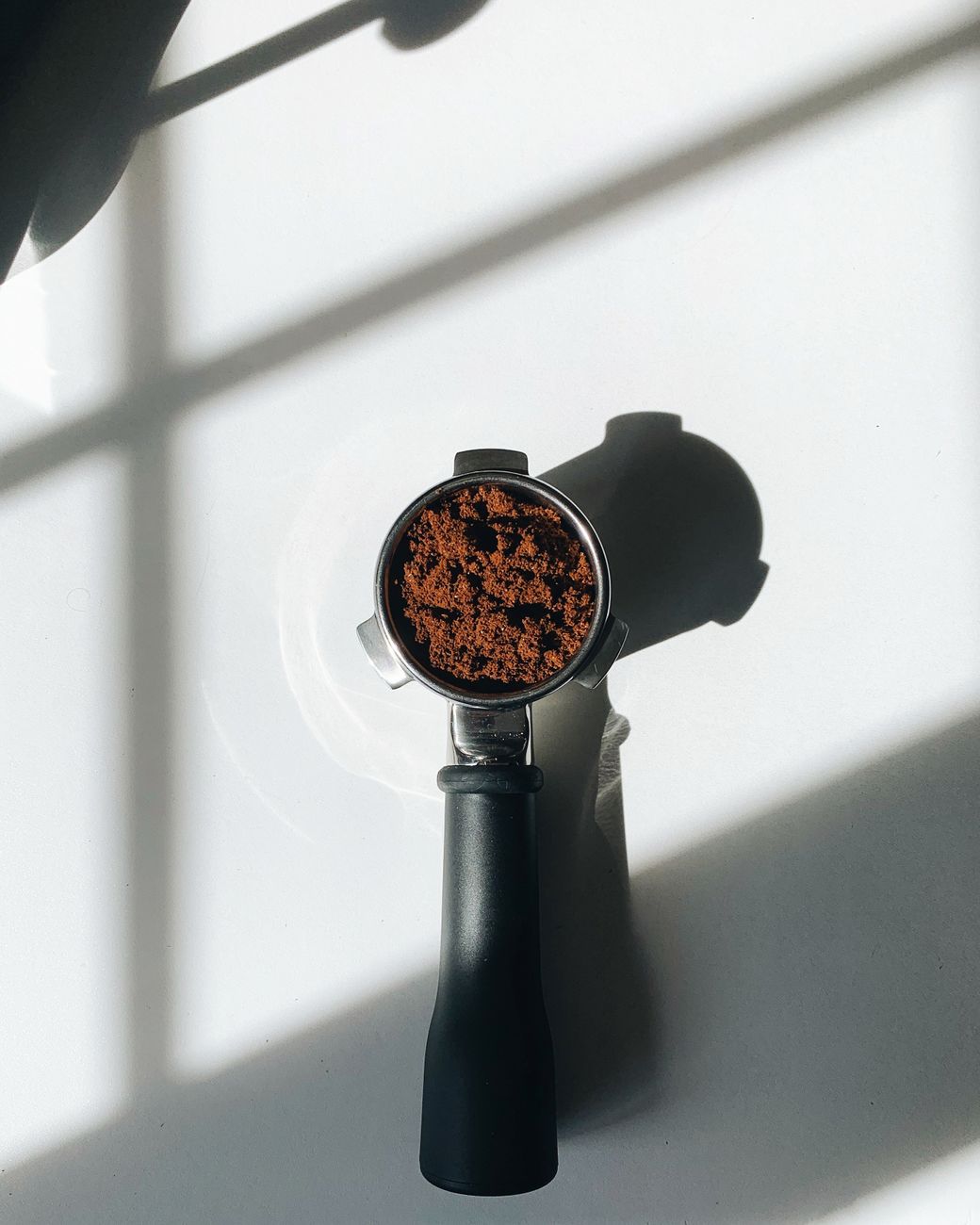
Here is the coffee grounds news for July 2026, seven separate developments spanning fuel, food science, farm soil and a cruise ship. What is being done with spent grounds now goes well past the compost heap.

Wet grounds turned into coal-grade fuel in 90 seconds
The biggest technical result of the month came out of South Korea. A team at the Korea Institute of Geoscience and Mineral Resources, led by Taejun Park in collaboration with GodTech Co., found a way to convert wet spent coffee grounds directly into high-quality biochar in 90 seconds, with no pre-drying and no oil removal.
Spent grounds come out of the machine at around 55% water, and drying them out first eats most of the energy you would get back from burning the result. The Korean method uses an atmospheric-pressure plasma jet fuelled by liquefied petroleum gas and compressed air, running at around 900 degrees Celsius. The pressurised heat flash-vaporises the water inside the grounds, setting off hundreds of tiny internal explosions that some describe as a popcorn effect. Mass drops by 83.3% and what is left is a dry, porous biochar.

Calorific value rises about 33% to 29 megajoules per kilogram, which is comparable to coal, and the biochar carries no sulfur. Specific energy consumption sits at roughly 154 megajoules per kilogram of biochar at optimal conditions. The researchers say the system is compact enough for decentralised on-site deployment, which removes the cost of trucking wet waste to a central facility. They also expect the process to work on other high-moisture organic wastes such as food waste, sewage sludge and agricultural residues.
The study was published in Chemical Engineering Journal. Covered by Anthropocene Magazine on 16 July and Bioenergy Insight on 8 July.
In July – Spent grounds pressed into a solid fuel briquette
A second fuel result, this one from authors in Indonesia, Malaysia and Japan, appeared in the July issue of Biomass and Bioenergy. They ran spent grounds through microwave-assisted pyrolysis and then densified the output into torrefied bio-coke.
Torrefaction lifts fixed carbon to 39.97% and brings volatile matter down to 56.60%. The densified product reaches a maximum compressive strength of 39.98 megapascals and an apparent density of 1.26 grams per cubic centimetre, which means it holds together as a handleable briquette rather than crumbling in transport. Calorific value reaches 27.10 megajoules per kilogram and total combustion time extends to 16.54 minutes.
Loose biochar is awkward to store and burns fast. A briquette that survives handling and burns for a quarter of an hour is a different product entirely, and it puts spent grounds into the same conversation as anaerobic digestion as a genuine energy pathway.
Source: Biomass and Bioenergy, volume 210, article 109094.
Recycled grounds used to protect coffee oil from going rancid
Researchers Claudia Passos and Silvia Petronilho, in the Department of Chemistry at the University of Aveiro in Portugal, published work on using spent grounds to make food emulsions that protect coffee oil from oxidation.
The oil comes out of the coffee grounds first. The defatted residue then goes through microwave-assisted extraction to recover polysaccharide-rich extracts at two temperatures, 150 Celsius and 180 Celsius. Both extracts are composed mainly of galactomannans and arabinogalactans, with the lower-temperature one carrying higher levels of chlorogenic acids, the compounds behind coffee’s antioxidant activity.
The emulsions held their stability and preserved the compounds responsible for coffee aroma, particularly furans, while limiting the release of aldehydes. Aldehydes are the markers of lipid oxidation and the cause of the stale, cardboard flavours that develop in old coffee. In short, the waste from the cup was used to keep the flavour of the cup intact.
Reported by The Portugal News on 20 July, via Lusa.
July news study – Biochar at origin needs composting before it does anything
The July/August issue of Global Coffee Report ran a piece on biochar use on coffee farms, and it contains the most practically useful detail of anything I read this month.
Biochar is not applied as a standalone input. On its own it is inert carbon with a lot of empty pore space and no biology in it. It has to be charged first through co-composting, and the article gives the working ratio: four parts fresh coffee pulp to one part biochar, with kitchen waste substituting for pulp where pulp is not available. The mixture composts for a minimum of six to eight weeks, with two to four months given as the optimal window to maximise nutrient loading and microbial colonisation.
That is directly transferable to a home setup. If you are making or buying biochar for a garden bed, the same principle holds. Raw biochar dropped into soil will initially pull nutrients out of it while the pores fill.
Source: Global Coffee Report, 22 July.
A cruise ship sending 2,800 pounds of coffee grounds ashore every week
Carnival Corporation announced its Community Coffee Grounds Initiative at Celebration Key in Grand Bahama on 15 July. Nearly 2,800 pounds of spent grounds are collected weekly from Carnival Cruise Line’s Mardi Gras, brought ashore, and used as compost and fertiliser across the destination’s landscaping.

The programme runs with Grand Bahama-based ATO Landscaping and targets soil nutrients, water retention and the long-term health of native palms and plant life. Students from local eco-schools take part, getting hands-on experience in composting, agriculture and circular resource use. It was formally introduced at Millennium House in downtown Freeport, at an event drawing leaders from government, education, agriculture and environmental organisations.
Most of the coffee grounds news for July 2026 comes out of a laboratory. This one is practical, the same basic idea as putting coffee grounds under street trees, just at a scale that needs a shipping manifest.
Source: National Law Review, carrying the Carnival Corporation July 2026 release.
Behind the coffee grounds news: ninety per cent still goes to landfill
A review published in Sustainable Futures by researchers at the University of Naples Parthenope and the University of Tuscia mapped 24 years of coffee sustainability research. They selected 137 peer-reviewed papers from 2000 to 2024 using PRISMA methodology and VOSviewer bibliometric mapping.
Publication activity accelerated from the late 2010s. The United States and Brazil dominate institutional output, followed by India, Italy and Indonesia, with significant gaps across Central America, East Africa and Southeast Asia.
More than 90% of spent coffee grounds still go to landfill, even though the literature documents viable uses in compost, fertilisers, cosmetics, energy, construction materials, food products and pharmaceuticals. Processing cost, regulatory barriers and the absence of common standards are the blockers. That gap between what works in a lab and what pays for itself is the same one that shapes every attempt at making money from used coffee grounds.
Reported by Daily Coffee News, 15 July.
Coffee pulp extract and cholesterol
The last item concerns coffee pulp rather than spent grounds. Pulp is the fruit flesh stripped from the bean during wet processing at origin, generated in far larger volumes than spent grounds and historically dumped or left to rot near the mills.
An industry-backed study reports a cholesterol-lowering effect from a pulp-derived extract, which positions the residue as a functional food ingredient rather than a disposal problem. The industry backing is flagged in the headline itself and is worth weighing when reading the result. I have not read the full paper, so I cannot speak to methods, dosages or effect sizes.
Reported by Daily Coffee News, 15 July.
And that is all things coffee grounds in the news for July 2026.


Leave a Reply