
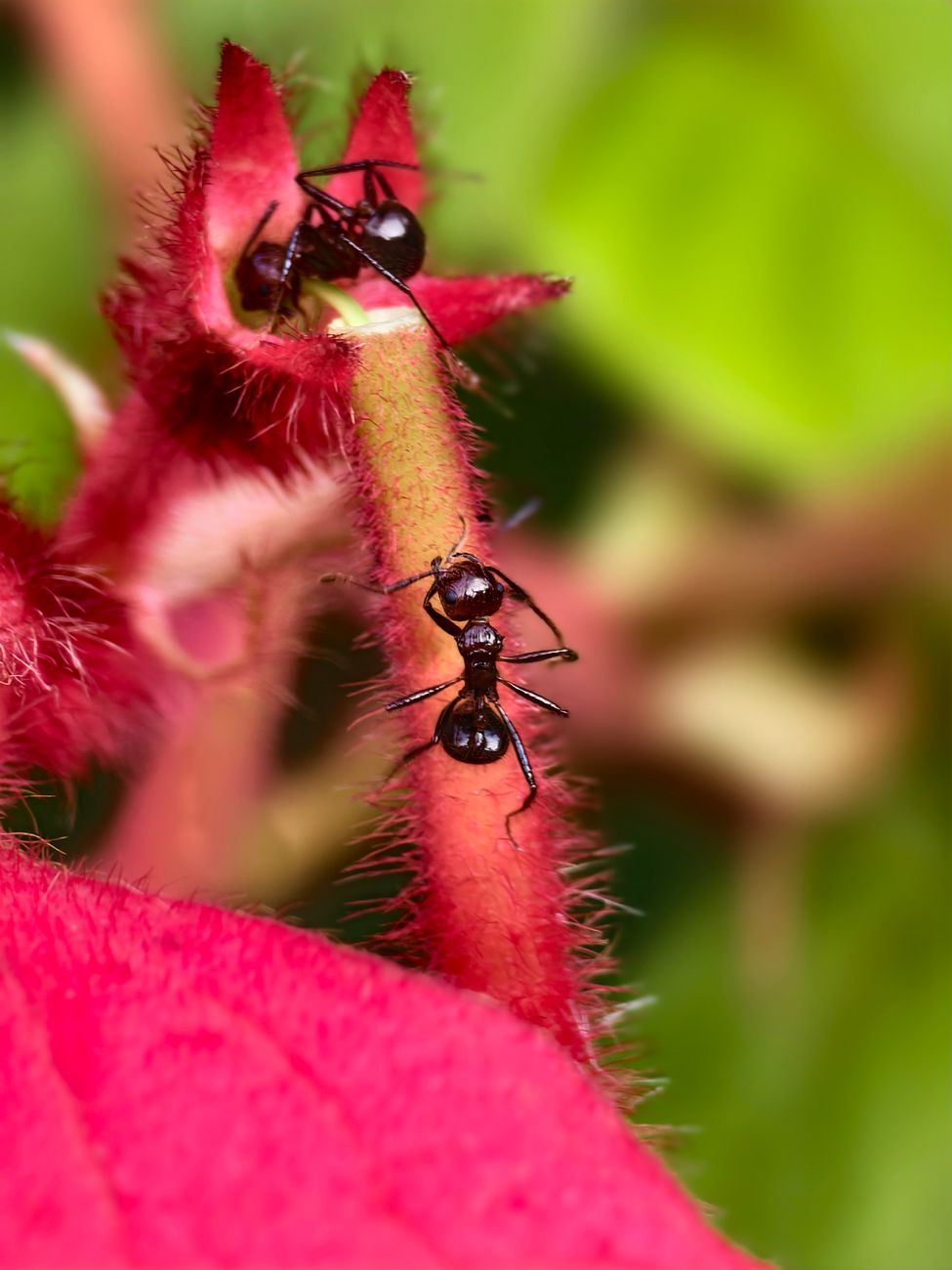
Are ants bad for your garden? Usually not. Ants get blamed for a lot in the garden that isn’t actually their fault. Most of the time they’re not the problem, they’re a symptom, or they’re just doing something genuinely useful underground where you can’t see it. Here’s what’s really going on, and where coffee grounds fit into the picture.

They’re farming your aphids, not attacking your plants
If you see a trail of ants running up a stem to a cluster of buds or new growth, the ants usually aren’t the ones doing the damage. They’re there for the aphids. Aphids feed on plant sap and excrete a sugary substance called honeydew, and ants love it. In exchange for the honeydew, ants protect the aphids from predators like ladybirds, which lets the aphid colony grow larger than it otherwise would. The Royal Horticultural Society notes that ants often have mutualistic associations with sap-feeding insects for exactly this reason.
It’s a proper mutualistic relationship, not just opportunism. Some ant species will move aphids to fresher growth when a plant starts to decline, carrying them the way a farmer might shift livestock to a new paddock. A few species even overwinter aphid eggs in their own nests to protect them from frost, then carry the newly hatched aphids back out to host plants in spring. That’s the scale of investment we’re talking about, so a few ants wandering a stem is rarely the full picture.
So if you’re trying to get ants off a plant, going after the ants directly is treating the symptom. Deal with the aphids first, whether that’s a strong water spray, hand-picking, or encouraging ladybirds and lacewings into the garden. The ants generally move on by themselves, because there’s nothing left worth farming. Spraying the ants alone tends to be a losing battle: you might clear one trail and another forms within a day, because the actual attraction, the aphids, is still sitting there.

Underground, they’re doing your soil a favour
Most ants nest in the ground, and the tunnelling that goes with that isn’t nothing. It aerates the soil and helps water and nutrients reach plant roots, like worms do in a compost bin. Ants move small amounts of organic matter and soil around as they build and maintain their nests. Over time this contributes to soil structure in a similar, if smaller-scale, way to earthworm activity. Some species are known to disperse seeds too, carrying them short distances and helping certain plants establish in new spots.
A few ants in a garden bed isn’t a sign of trouble, it’s a sign the soil has some life in it. The exceptions worth knowing are the more troublesome species, carpenter ants can damage timber structures and raised bed frames over time, and fire ants build large, aggressive mounds that are worth dealing with directly. But the common black garden ant most of us see day to day is doing more good than harm.
Do coffee grounds actually repel them?
Short answer: sometimes, mildly, and not reliably enough to count on for anything serious. A 2018 study in the Pertanika Journal of Tropical Agricultural Science tested coffee extracts against three household ant species. They found that Coffea arabica extracts caused the highest mortality, with higher concentrations producing stronger effects in most trials. But the same body of research found that caffeine’s effect on ants isn’t consistent. At some concentrations it repels them, at others it can actually make coffee more attractive as bait. This is likely because a moderate dose makes the food source seem more valuable rather than less. Dose matters more than the folk wisdom suggests, and what works on one species doesn’t necessarily work on another.
There’s also a separate, more applied study worth knowing about. Researchers tested a spent coffee ground extract as pest control on green bean crops. It targeted aphids and several other common pests. The extract contained a mix of phenolic acids, flavonoids, and caffeine. It showed real repellent and antifeedant effects against the pests tested. That’s not about ants directly. But it’s a decent reminder that spent grounds aren’t inert once you’re done with your coffee, either in garden beds or compost. If it’s doing something to aphids, it’s arguably doing more for your ant problem than the ants suggest. The two are so often connected.
In practice, if you scatter a light, dry layer of used grounds around an entry point or along a garden edge, you might see ants reroute for a few days. It won’t touch the nest or the queen, and it won’t stop a determined colony for long. Colonies are perfectly capable of finding a new route around a patch of grounds once they realise nothing there is actually dangerous. Wet, clumped grounds are worse than useless too, they can mould and end up attracting other insects instead. Treat coffee grounds as a mild, temporary nuisance for the ants rather than pest control, and pair it with dealing with whatever food source drew them there in the first place.

Ants in the compost bin
A few ants in the compost heap are usually fine, and they can even help break down material by shredding it into smaller pieces as they tunnel. Large numbers usually mean the pile has gone too dry. Ants tend to move into compost that isn’t being turned or moistened enough, since a dry, undisturbed heap looks a lot like an ideal nesting site to them. Turning the pile and keeping it damp does more to move them on than any additive will, since it disrupts the exact conditions they were after.
If you want a light deterrent on top, a thin scattering of coffee grounds can help. The acidity and moisture-holding nature of grounds make the top layer less appealing to them without impacting the worms underneath. Worth noting that this is separate from vermicomposting specifically, where coffee grounds are a welcome feed rather than a deterrent. The two systems call for slightly different thinking. In a general compost heap, ants are a minor nuisance to manage. Yet in a worm farm, your priority is keeping conditions right for the worms, and healthy worms outcompete ants for space.
The Summary
Ants on a plant means check for aphids first. Ants in the soil are usually harmless and sometimes helpful, aside from the handful of troublesome species. Coffee grounds are a mild, short-lived deterrent, not a fix, and the evidence for them is more nuanced than the usual household tip suggests. And ants in the compost bin are more often a moisture problem than an ant problem. Most of the time, the ants themselves aren’t the thing worth fighting.

Leave a Reply